
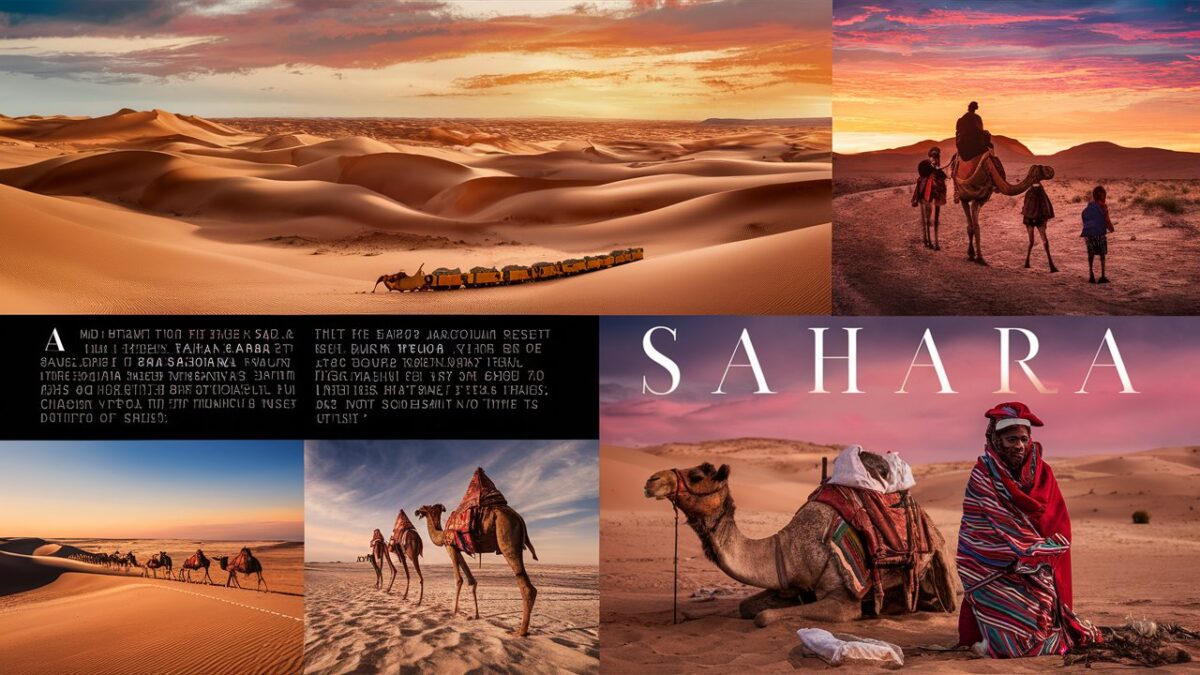

The term “Saharassa” is often used as a conceptual or stylized reference inspired by the word “Sahara,” which is associated with one of the largest and most iconic deserts in the world. In many contexts, Saharassa symbolizes vastness, silence, endurance, and extreme natural environments that challenge both human survival and imagination. While “Saharassa” itself is not a formally recognized geographical name, it is commonly interpreted as a creative or linguistic variation that reflects the essence of desert life, particularly the grandeur and mystery associated with desert ecosystems. This article explores Saharassa as a symbolic idea, its connection to desert landscapes, cultural meanings, environmental importance, and its broader metaphorical significance in literature and modern usage.
Saharassa and Its Connection to the Sahara Desert
To understand Saharassa properly, it is important to connect it with the real-world inspiration behind it, the Sahara Desert. The Sahara is the largest hot desert on Earth, covering a massive portion of North Africa and shaping the climate, culture, and ecology of the region. Sahara Desert represents an environment of extreme conditions where life has adapted in unique and resilient ways. When people use the term Saharassa, they often evoke similar imagery—endless sand dunes, scorching heat, and landscapes that stretch beyond the horizon. This connection helps transform Saharassa into a symbolic term representing endurance, isolation, and natural power rather than just a literal place.
Saharassa as a Symbol of Natural Extremes
Saharassa can be understood as a metaphor for extreme natural environments where survival depends on adaptation, resilience, and resourcefulness. In such landscapes, water becomes the most precious resource, and every living organism must evolve strategies to endure harsh temperatures and limited vegetation. This symbolic interpretation makes Saharassa more than just a name; it becomes a representation of nature’s toughest conditions. Writers and thinkers often use such imagery to describe emotional or psychological states, comparing human struggle to the relentless challenges of desert life. The idea of Saharassa therefore extends beyond geography into philosophy and human experience.
Environmental Importance of Saharassa-like Landscapes
Desert ecosystems, including those represented by the concept of Saharassa, play a critical role in global environmental balance. These regions influence weather patterns, wind systems, and even ocean currents. Although deserts may appear lifeless at first glance, they are actually home to specialized plants, insects, reptiles, and mammals that have adapted uniquely to survive. The Saharassa concept reminds us that even the harshest environments are ecologically significant. Furthermore, deserts act as natural laboratories for studying climate change, water conservation, and biodiversity adaptation. Understanding such ecosystems helps scientists predict environmental shifts and develop sustainable solutions for future challenges.
Cultural and Historical Significance of Saharassa
Throughout history, desert regions have shaped human civilizations in profound ways. Trade routes, migration patterns, and cultural exchanges have often passed through desert landscapes, connecting distant societies. In a symbolic sense, Saharassa represents this intersection of isolation and connection. Many ancient communities developed unique traditions, music, clothing, and storytelling styles inspired by desert life. The vast emptiness of the desert also influenced spiritual and philosophical thinking, where silence and solitude were seen as pathways to deeper understanding. Thus, Saharassa becomes a cultural metaphor for both separation and unity in human history.
Saharassa in Literature and Modern Expression
In literature and modern creative expression, Saharassa is often used as a poetic or artistic term to describe vast emotional landscapes. Writers may use it to symbolize loneliness, inner strength, or personal transformation. Just as deserts stretch endlessly without visible boundaries, human emotions can also feel vast and unexplored. Saharassa, in this sense, becomes a narrative tool that allows authors to express complex psychological states. In modern digital culture, it may also appear as a brand name, artistic identity, or conceptual theme representing minimalism, endurance, or natural beauty.
Environmental Challenges and Future of Saharassa-like Regions
Desert regions face increasing environmental challenges due to climate change, desertification, and human activity. Expanding desert boundaries threaten agricultural land and water resources, making sustainability a global concern. The concept of Saharassa highlights the importance of protecting fragile ecosystems while also understanding their natural evolution. Scientists continue to study how deserts expand and contract over time, and how human intervention can either harm or help these environments. The future of Saharassa-like regions depends on responsible environmental management and global awareness of ecological balance.
Conclusion: The Deeper Meaning of Saharassa
Saharassa is more than just a word—it is a symbolic representation of vast deserts, extreme environments, and human resilience. Whether interpreted through the lens of geography, culture, or metaphor, it reflects the powerful relationship between humans and nature. Inspired by real desert landscapes like the Sahara Desert, Saharassa reminds us of the beauty hidden within harsh conditions and the strength required to survive in them. It also serves as a reminder that even the most isolated and extreme places on Earth have meaning, history, and ecological importance.
Frequently Asked Questions (FAQs)
1. What does Saharassa mean?
Saharassa is a conceptual or stylized term inspired by desert landscapes, often symbolizing vastness, endurance, and extreme natural environments.
2. Is Saharassa a real place?
No, Saharassa is not an officially recognized geographical location. It is usually used as a symbolic or creative variation related to desert themes.
3. What is the connection between Saharassa and the Sahara Desert?
Saharassa is closely associated in meaning with the Sahara Desert, which is the largest hot desert in the world and represents extreme environmental conditions.
4. Why is Saharassa used in literature?
Writers use Saharassa as a metaphor for isolation, emotional depth, transformation, and resilience, similar to how deserts symbolize vast internal or external journeys.
5. What is the environmental importance of Saharassa-like regions?
Such regions play a key role in climate systems, biodiversity adaptation, and ecological research, helping scientists understand environmental change.
6. Can life exist in Saharassa-type environments?
Yes, despite harsh conditions, deserts support specialized plants and animals that have adapted to survive with minimal water and extreme temperatures.